Channel Formations
Map of Fluvial Landforms
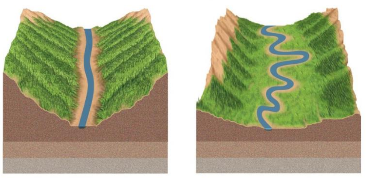
Channel formations can be defined based on their sinuousity (the difference between the channel length and the valley length: a more sinuous stream will have a much longer channel length than the length of the valley, while a less sinuous stream will have a channel length fairly similar to its valley length.) A stream with low sinuousity is described as "straight". While a stream with high sinuousity is described as "meandering".
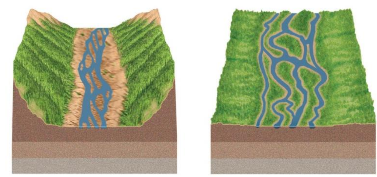
Streams that flow through multiple interconnected channels in the same valley can be defined based on the stability of those interconnected channels. Braided streams have unvegetated bars separating the channels. Bars remain unvegetated because where bars are located within the channel changes rapidly enough to not provide vegetation long enough to grow. Braided streams are usually defined by high deposition rates, which causes the channel to rapidly migrate through its valley. Anastomosing streams have vegetated bars (sometimes called islands when the stream is anastomosing) separating the channels. Vegetation is indicative of the stability of the stream's distinct channels.